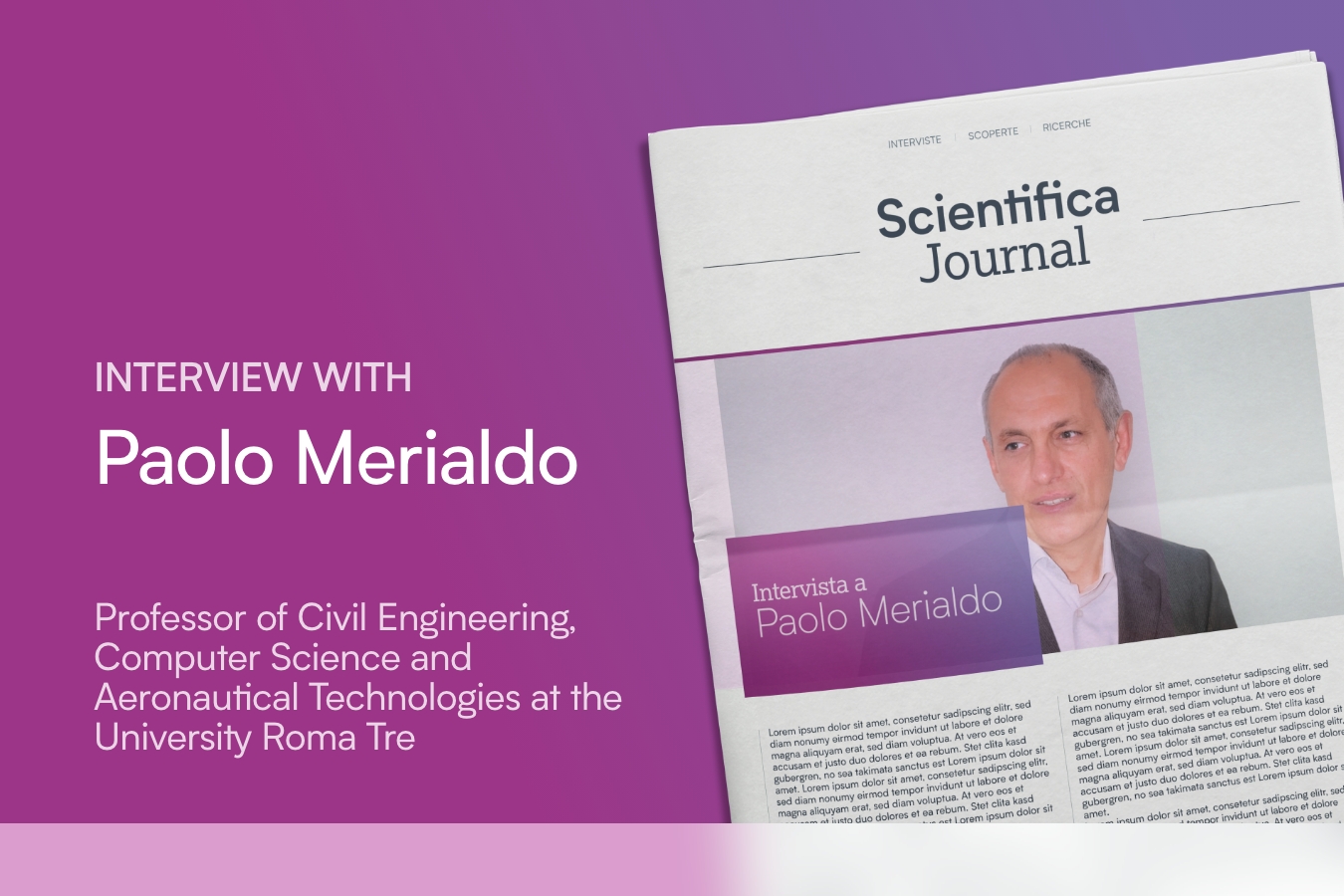
For this new edition of Scientifica Journal, we delve into the fascinating world of computational cognitive neuroscience — a branch of neuroscience that uses mathematical models to optimally manage and analyze large volumes of data derived from the study of complex biological systems.
Guiding us on this journey is Professor Massimiliano Garagnani, Professor of Computer Science at the University of London, who offers us a privileged perspective on his academic background and current research projects.
Let’s start from the beginning. Can you tell us how your research career began and what your academic background is?
I started with a degree in Information Science from the University of Bologna, followed by two PhDs: one in Artificial Intelligence from Durham University in the UK, and another in Computational Cognitive Neuroscience from the University of Cambridge.
Right after my first PhD, I was awarded a five-year Research Fellowship at The Open University (UK), which allowed me to spend time as a Visiting Scholar at the International Computer Science Institute (ICSI) in Berkeley (USA), where I had the honor of working with Dr. Lokendra Shastri for six months.
It was through that experience that I began working in the field of computational neuroscience for the first time.
After that, I received funding from the UK Medical Research Council to undertake my second PhD, this time at Cambridge. That second PhD opened the doors to research in computational cognitive neuroscience.
Regarding your research activity, what are the main areas in which you’ve specialized?
During my Research Fellowship at The Open University, I worked in the field of Artificial Intelligence, particularly in the subfields of automated planning and knowledge representation.
However, it was during my second PhD that I specialized in computational cognitive neuroscience, focusing specifically on the development and application of brain-constrained neurocomputational models, models that closely replicate the structure and dynamics of the human brain.
This research simulates higher cognitive functions such as language and decision-making, using learning mechanisms found exclusively in the cerebral cortex, all starting from a neural network that is initially knowledge-free, containing only randomly generated connections.
Very interesting. Among the research you’re currently working on, which would you say is the most relevant?
Well, one of the most interesting projects is certainly modeling the emergence of individual decision-making in a realistic computational model of the brain. In other words, studying the emergence of “free will.”
Previously, a model of cortical areas in the frontal and temporal lobes revealed spontaneous, pseudo-random activity that was similar to the neural behavior observed in the human brain immediately before and during simple “action” decisions.
The goal of my research is to improve this existing model so that the end result is a brain-realistic neural network system capable of acquiring, as a result of experience, a primitive form of “artificial free will” and intrinsic “pleasure-seeking” behavior, as typically observed in humans and other animals during development.
To achieve this goal, we first introduced artificial “spiking” cells, resulting in a more biologically accurate model; Secondly, we fine-tuned the model’s parameters so that its macroscopic behavior replicates that of real subjects; and finally, we introduced a dopaminergic modulatory component into the learning mechanism, simulating the presence of the “reward.” This will equip the artificial system with the ability to naturally develop “pleasure-seeking” behavior such that spontaneously generated action intentions are no longer pseudo-random, but are chosen based on the expected reward.
If you had to tell us about the most rewarding discovery or experience of your scientific career, what would it be?
The most remarkable discovery for me was observing that the neurocomputational model I had developed displayed spontaneous activity, an unexpected and yet not erroneous behavior, which had not been pre-programmed into its artificial neural circuits.
This type of spontaneous behavior can be considered, within the field of artificial intelligence and neural networks, as a primitive form of what is usually referred to as “free will.”
Given your extensive experience, what advice would you give to researchers looking to keep their passion for science alive?
In my experience, what keeps the passion for research alive is the need to uncover truth in the face of mystery. To quote Albert Einstein: “The most beautiful and profound emotion we can experience is the sense of the mysterious. It is the source of all true art and science.”
Thank you, Professor Garagnani, for sharing your story with us.
Stay with us as we continue to explore the frontiers of innovation. Through the eyes of the scientists we interview, we’ll keep venturing into the ever-expanding boundaries of science and discovery.